Pilgrims and Fortresses: Santiago de Compostela and the Castles That Guarded a Frontier
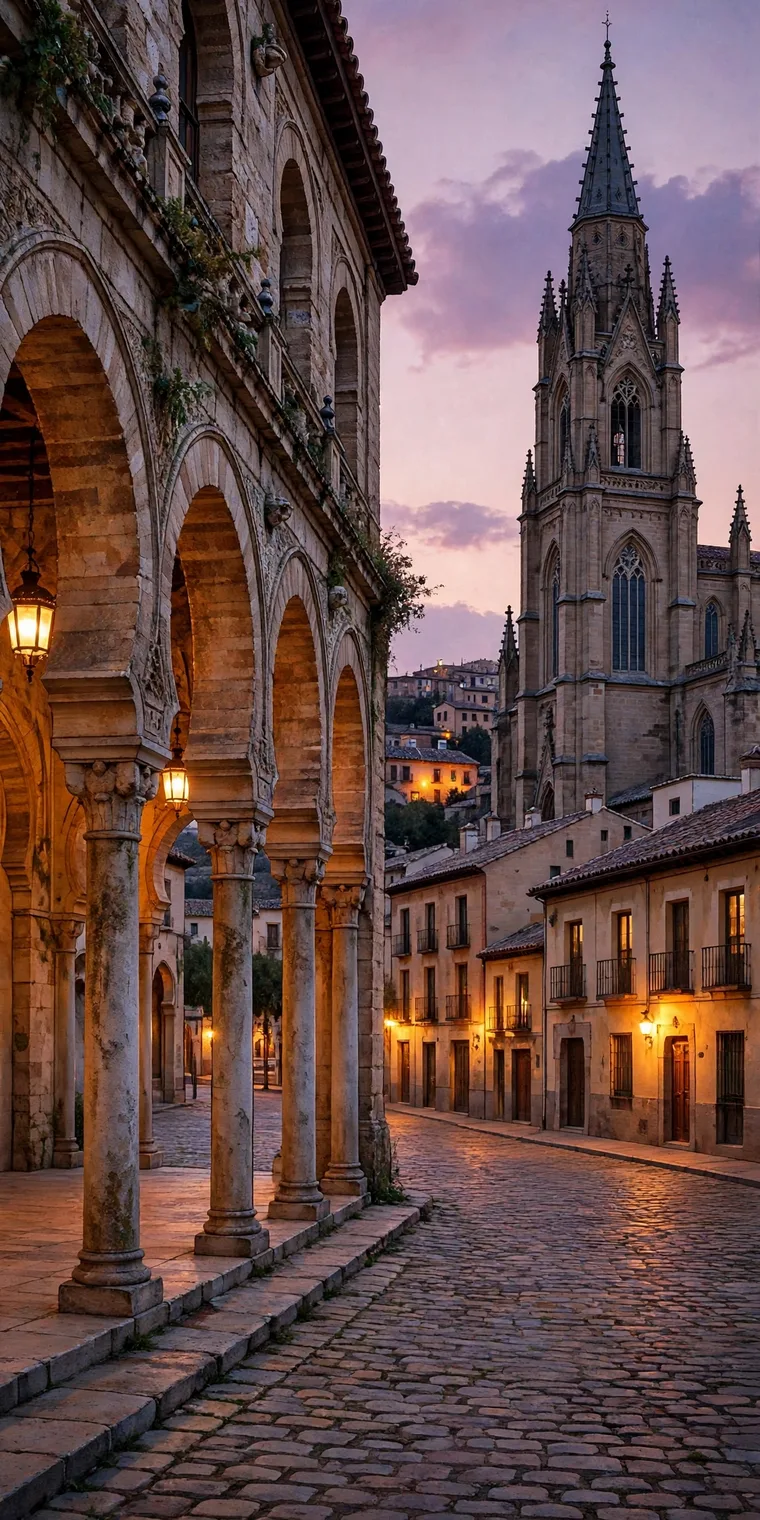
Medieval Spain was built facing two directions at once: toward a tomb in the far northwest that drew pilgrims from across Europe, and toward a contested frontier that moved south, generation by generation, for nearly eight centuries. The architecture of that double movement still defines the country. At one end stands the Cathedral of Santiago de Compostela, the most emotionally charged church in Spain. Across the meseta and the hilltops between the Duero and the Ebro stand thousands of castles — so many that the central region took its name, Castile, from them: the land of castles.
They belong in the same story. Pilgrims needed roads, bridges, hospitals and protection. Lords who held frontier land built towers to see danger coming. Faith and defence were not separate budgets in medieval Spain. They were the same project.
Santiago: The End of the Earth Becomes a Destination
According to tradition, the tomb of the apostle James the Greater — Santiago in Spanish — was discovered in the early 9th century in Galicia, in what had seemed the end of the known world. By the 11th and 12th centuries the Camino de Santiago had become one of the three great pilgrimages of Christendom, alongside Rome and Jerusalem. The present cathedral, begun in 1075, was designed to receive a continent.
It is, at heart, a Romanesque pilgrim church on a grand scale: a Latin cross plan with an ambulatory and radiating chapels, so crowds could circulate past the shrine without choking the liturgy. Pilgrims moved around the saint, embraced the figure of Santiago behind the high altar and descended to the crypt — and many still do, whether they arrive after 800 kilometres on the Camino Francés or after a short walk from a bus.
The cathedral's greatest Romanesque glory is the Pórtico de la Gloria, carved by Master Mateo and completed in 1188. Prophets, apostles and the Last Judgment crowd its three arches, with Christ in Majesty at the centre and Santiago seated on the column below. Generations of pilgrims placed their hands on that column so often that five finger-shaped grooves were worn into the stone — art touched smooth by devotion, now protected but unforgettable as evidence.
Centuries added their layers outside. The Obradoiro Façade, the great Baroque front dominating the square where pilgrims finish, was built in the 18th century by Fernando de Casas Novoa. It also shields Mateo's portal from Galician rain — preservation disguised as splendour. Other sides speak other centuries, so walking around the building is walking around its biography.
Inside, during solemn liturgies, the Botafumeiro — one of the largest thuribles in the world, at about 53 kilograms — is swung by eight tiraboleiros on ropes from the transept crossing, arcing nearly to the vaults in a trail of incense. Tradition says it began as practical fumigation for crowds of unwashed pilgrims. Whatever its origins, no visitor forgets it: engineering, theatre and prayer in a single pendulum.
Santiago's city completes the cathedral. Granite arcades line streets built for rain, and the Hostal de los Reyes Católicos, founded by Ferdinand and Isabella as a pilgrims' hospital in 1499, faces the cathedral across the Praza do Obradoiro. The whole old town understands that arrival is a ceremony. Few European cities are organised so completely around a single human act: finishing a journey.
A Land Named for Castles
Spain is often said to preserve some 2,500 castles and fortified sites, with many thousands more lost or reduced to a single tower. They cluster where history demanded them: along the frontier between Christian and Muslim territories, on borders between rival Christian kingdoms, and above the roads, rivers and passes armies had to use. A Spanish road trip that ignores them is missing the country's original skyline.
Segovia's Alcázar is the one most visitors think they already know — a ship-like fortress on a rocky outcrop at the confluence of two rivers, its slate spires giving it a fairytale profile. Look past the silhouette and it is serious history. A fortress stood here from Roman and early medieval times; the Alcázar became a favoured royal residence of the kings of Castile, and Isabella was proclaimed queen here in 1474. Fire in 1862 and careful restoration shaped much of what you see. Inside, the Hall of Kings and the throne room explain its double life: stronghold outside, palace within — the exact combination frontier monarchy required.
Elsewhere the castles are less polished and often more eloquent. The Castillo de Loarre in Huesca, begun in the 11th century, is among the finest Romanesque fortresses in Europe, climbing a rock above the Pyrenean foothills as Aragon pushed south. Peñafiel in Valladolid province stretches along a narrow ridge like a stone ship above Duero wine country; its keep now houses a wine museum, a very Spanish reuse. Belmonte in Cuenca, a 15th-century Gothic-Mudéjar palace-fortress, shows the moment castles became statements of noble status, with rich interiors behind defensible walls. Manzanares el Real near Madrid does the same for the Mendoza family. Coca in Segovia province, built in brick in the Mudéjar tradition, proves a fortress could be formidable and decorative at once — pinkish brickwork, a deep moat and ornate towers unlike anything in northern Europe.
Many castles were never royal at all. Small watchtowers — atalayas, a word from Arabic — dot Andalusia and the old frontier zones, built to pass fire and smoke signals from ridge to ridge. Nasrid and Christian lines of towers stared at each other across valleys for generations. The Reconquista was not a single march. It was centuries of watching.
What the Middle Ages Left Behind
Some castles became palaces, some prisons, some quarries, and some — from the 20th century onward — paradors, the state-run hotels that saved many monuments by giving them a paying job. Sleeping in a castle parador in Sigüenza, Cardona or Olite is not a gimmick; it is the preservation model that kept the roofs on.
Pair a pilgrimage city with its region's castles, and notice the materials — granite in Galicia, brick in Mudéjar Castile — and what each building faces. A cathedral faces the arriving pilgrim. A castle faces danger.
Between those two gazes — welcome and warning — medieval Spain built itself. The finger-worn stone of Master Mateo's column and the smoke-signal towers of the frontier are the same civilisation speaking: we are here, we intend to stay, and we will build that intention so well you can still touch it eight hundred years later.
© 2026 InsideRealSpain.com