How to Eat Like You Live Here: Tapas, the Menú del Día, and Spain's Liquid Gold
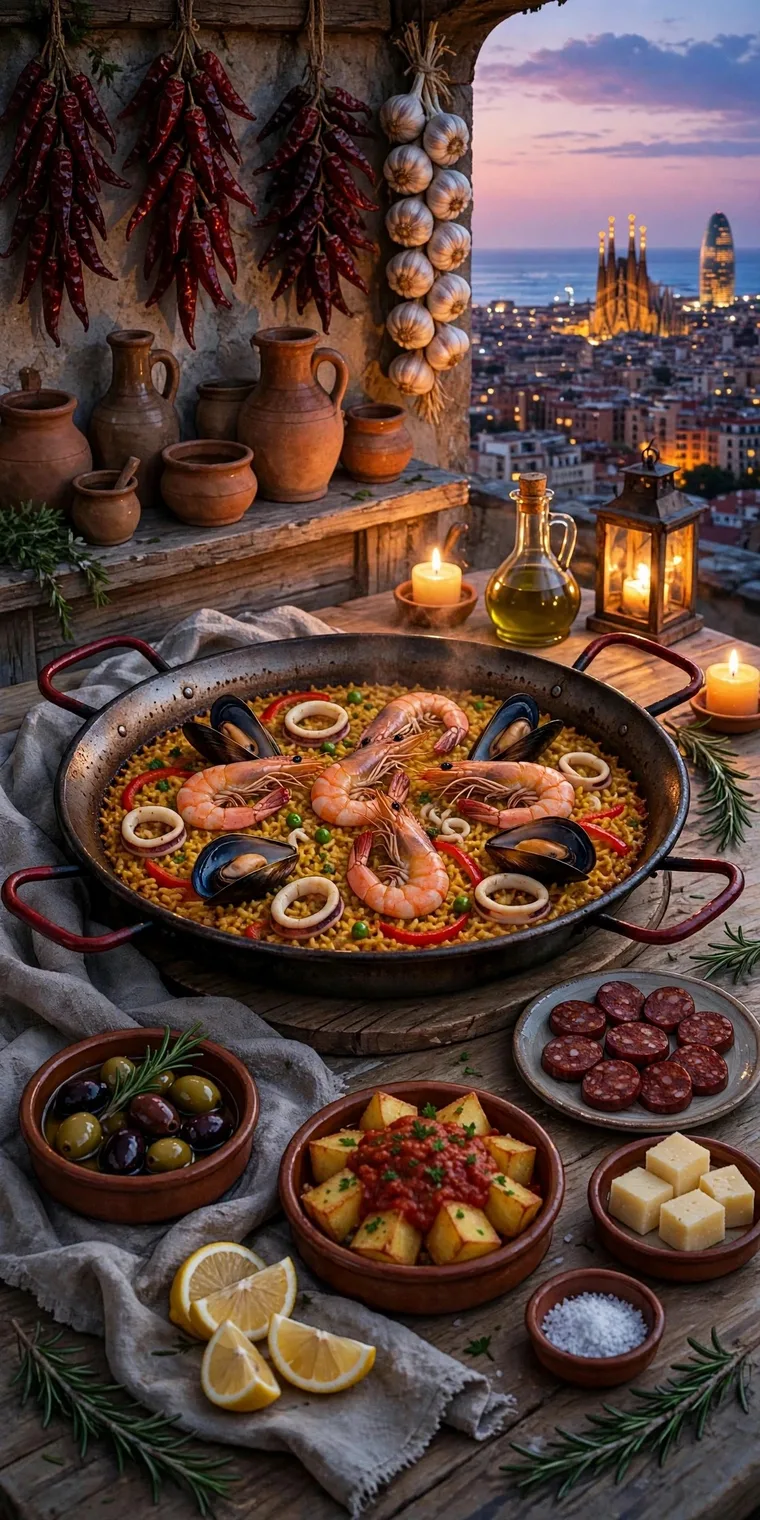
Visitors to Spain often plan their eating around restaurants. Spaniards plan theirs around systems: the tapa that turns a drink into an event, the menú del día that feeds a whole country lunch for the price of a sandwich elsewhere, and the olive oil that goes into almost everything before a recipe even starts. Learn those three systems and you stop eating like a tourist with a list. You start eating like somebody who lives here — well, cheaply, and at the right hours.
Tapas: a verb disguised as a noun
Tapa means a lid, and the usual origin story — a slice of ham or bread laid over a glass of sherry in Andalusia to keep out flies and dust — is probably too neat, but the logic is real: in Spain, a drink historically arrived with something on top of it, and that something became a cuisine. What matters today is the grammar, because tapas are not a list of dishes. They are a format, and the same plate can appear in three sizes: a tapa, a small tasting portion; a media ración, half a sharing plate; and a ración, a full plate for the table. Gambas al ajillo — prawns sizzling in oil with garlic and chilli — can be any of the three. So can ensaladilla rusa, the potato salad with tuna and mayonnaise every bar makes and every regular judges it by, or boquerones en vinagre, white anchovies cured in vinegar with parsley.
In much of Spain you pay for tapas. In Granada — and in parts of Jaén, Almería and León — a free tapa still arrives with each drink, growing more elaborate with each round, a tradition so beloved that going for tapas in Granada is a complete and economical dinner strategy. Everywhere, the verb is tapear and the movement is the point: you do not commit to one kitchen. You have a caña — a small draft beer, about 200 millilitres, cold and quickly finished — here, a glass of vermouth there (vermut de grifo, on tap, with an olive and orange, is the aperitif of the moment, especially before Sunday lunch), and you let the evening accumulate.
How to order without panic
Eat at the barra, the bar, where tapas are fastest and cheapest; the same items on a terrace may carry a supplement, and a table inside is for sit-down meals. In busy bars, be politely assertive: catch the waiter's eye, order drinks and food in one go, and do not be offended by volume — Spanish bars are loud because they are working.
Learn a few phrases and use them everywhere. Una caña, por favor. ¿Qué tapas tienen hoy? — what tapas do you have today, because the best are often off-menu. La cuenta, por favor, at the end; in tapas bars you settle the whole bill at once, on trust, another small miracle of the system. Watch what the regulars eat and point if you must: uno de esos. Respect the clock: lunch runs roughly 1:30 to 3:30, dinner rarely before 9, often after 10 in summer. Kitchens close between services. The bar that looks dead at six is not failing; it is waiting.
Above all, order in rounds: two or three shared plates, eaten and assessed, then two or three more. It is grazing with rules, and the rules are what make it civilised.
Menú del día: the workers' lunch that ate the country
If tapas own the evening, the menú del día owns the midday. Born in the 1960s as a regulated tourist menu and kept alive by something stronger than regulation — the Spanish insistence on a proper cooked lunch — it is a fixed-price, multi-course meal served on working days everywhere from truck stops to white-tablecloth restaurants filling their dining rooms at noon.
The structure is liturgical. Primeros to choose from: soup, pasta, rice, salad, vegetables or legumes — a lentil stew, gazpacho in summer, a caldo in winter. Segundos: grilled fish, a stew, chicken, pork, an omelette — always something cooked, not assembled. Then pan, bebida y postre: bread, a drink included (water, beer or house wine), and dessert or coffee. Prices in ordinary neighbourhood restaurants commonly run from twelve to eighteen euros; in Madrid and Barcelona fifteen to twenty-five is now normal. For three courses and a drink, it remains one of Europe's great bargains.
Judge it as locals do. Good signs: several choices per course, a legume or vegetable primero, a fish segundo, a daily-printed menu, a room full of workers and grandparents at two o'clock. Bad signs: photographs, a laminated menu in six languages, nobody local. The menú is also your best route into home cooking restaurants rarely serve at night: fabada, cocido, lentejas con chorizo, escudella. The stews of Spain live at lunchtime.
Olive oil: the ingredient under everything
Underneath both systems runs the third: aceite de oliva. Spain is the world's largest olive oil producer by a wide margin, in most years supplying around half the planet's output, and Jaén in Andalusia — a silver-green sea of some sixty million olive trees — produces more than many entire countries. This is not a garnish culture. Oil is the cooking medium, the dressing, the preservative and, at breakfast, the main event: tostada con aceite, hot toast rubbed with tomato and flooded with fresh oil, eaten standing at bars across Andalusia every morning.
Buy and taste it by variety. Picual, Jaén's workhorse, is peppery, green and stable for frying. Arbequina, from Catalonia, is soft and fruity, made for salads. Hojiblanca is grassy and almond-sweet; Cornicabra, from Toledo, robust and bitter-edged. The grade that matters is aceite de oliva virgen extra — extra virgin, mechanically extracted, acidity below 0.8 percent — and harvest date matters more than brand: new oil, in the months after the autumn harvest, is electric green and pungent enough to catch the back of your throat, a pepperiness that signals the polyphenols making this oil genuinely good for you. Spaniards fry in it without anxiety, and tortilla de patatas — potato slowly confited in oil, then set with egg — is unthinkable in anything else.
That tortilla, in wedges at room temperature, closes the circle: it is a tapa, a menú primero and a family lunch — potato, egg and the oil Spain makes better than anywhere on Earth. Learn the systems, and Spain stops being a cuisine you visit. It becomes one you can operate, like a local.
© 2026 InsideRealSpain.com