Two Summers, One Red Shirt: La Roja from 2010 Glory to the Kids of Euro 2024
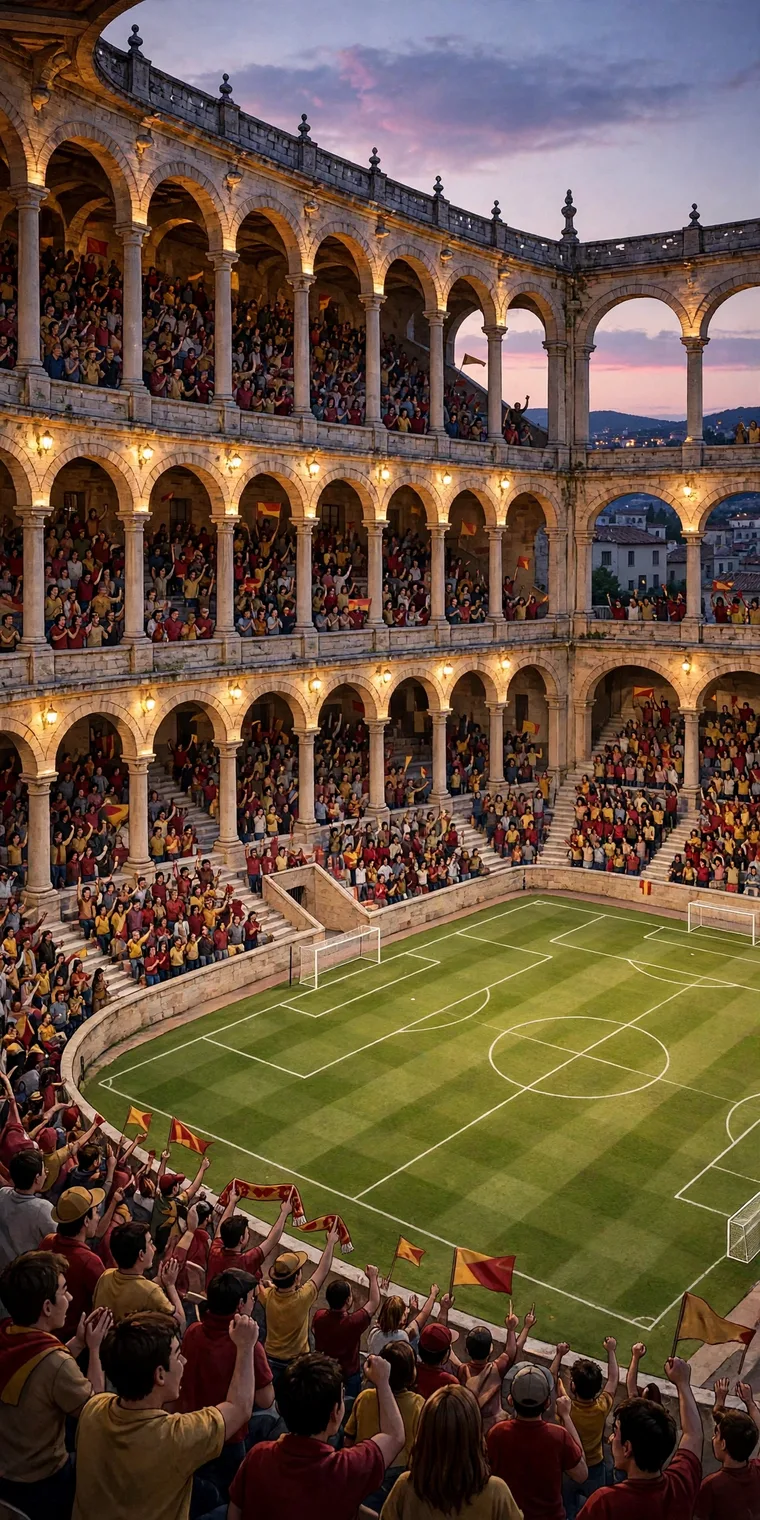
For most of the twentieth century, Spain's national team was a story of talent that arrived early at tournaments and left early too. Quarter-finals became a curse: gifted players, famous clubs, and a team that seemed to shrink in red. Then, in six years, Spain won everything — Euro 2008, the 2010 World Cup, and Euro 2012 — and in 2024 it won again, at the European Championship in Germany, playing a faster, freer football that felt both familiar and new. La Roja is not one team. It is two golden generations and the painful rebuilding between them.
Johannesburg, 11 July 2010
The 2010 final against the Netherlands in Soccer City was not beautiful, and nobody in Spain pretends otherwise. It was tense, foul-ridden and scoreless for 116 minutes. The Dutch tried to disrupt Spain's passing; Spain, coached by Vicente del Bosque, refused to abandon it. When Andrés Iniesta, receiving from Cesc Fàbregas, drove the ball past Maarten Stekelenburg in extra time, he tore off his shirt to reveal a vest in memory of Dani Jarque, the Espanyol captain who had died the previous year aged twenty-six. That gesture — triumph carrying grief inside it — fixed the night in Spanish memory as something larger than a result.
Iniesta's goal crowned a method. Its roots lay in Euro 2008 under Luis Aragonés, who had built a side around small, technically superb midfielders — Xavi Hernández, Iniesta, David Silva, Fàbregas — and trusted possession as defence. If the other team did not have the ball, it could not hurt you. Del Bosque, succeeding Aragonés, kept the system and calmed its temperament. Iker Casillas captained from goal, Carles Puyol and Gerard Piqué anchored the defence, Sergio Busquets screened, Xabi Alonso distributed, and David Villa and Fernando Torres provided goals. At Euro 2012 in Kyiv, Spain destroyed Italy 4-0 in the final, the most complete performance of the era. Three consecutive major trophies: no European nation had done it.
What changed off the pitch mattered as much. A country with powerful regional identities, where many fans put club and autonomous community first, had found in La Roja a shared flag that did not feel forced. In the summer of 2010, balconies in Barcelona, Bilbao, Seville and Madrid flew the same red shirt. Political arguments did not disappear — Spain remained Spain — but for a month the national team was the easiest form of patriotism available: young, skilful, untainted by history, and, crucially, winners.
The Long Fall
Empires in football end abruptly. At the 2014 World Cup in Brazil, Spain lost 5-1 to the Netherlands in its opening game and went out in the group stage. The core aged together, opponents had learned to press the passing lanes, and the hunger that sustains a system had thinned. What followed was a decade of false dawns: a chaotic 2018 World Cup, when coach Julen Lopetegui was sacked on the eve of the tournament after agreeing to join Real Madrid; a promising Euro 2020 semi-final under Luis Enrique; a frustrating 2022 World Cup exit to Morocco on penalties, after a possession display that produced almost no threat. That last defeat crystallised the critique of the old style. Passing for its own sake, critics said, had become sterile — a museum version of 2010. Spain had the ball. Spain did not have a cutting edge.
The federation turned to Luis de la Fuente, a quiet coach who had won European titles with Spain's under-19 and under-21 teams and knew the incoming generation personally. It was not a glamorous appointment. It proved to be the right one.
Berlin, 14 July 2024
Spain arrived at Euro 2024 respected but not favoured, behind France, England and hosts Germany in most predictions. It left as the only team to win all seven matches, and as the first nation to win four European Championships.
De la Fuente kept the inheritance — Rodri, the Manchester City midfielder who would win the Ballon d'Or that year, controlling tempo beside Fabián Ruiz; Unai Simón in goal; possession as a base — and then broke the old pattern where it mattered: on the wings. Nico Williams, of Athletic Bilbao, on the left, and Lamine Yamal, of Barcelona, on the right, gave Spain direct, one-against-one speed that forced defences backwards and made the midfield passing dangerous again. Yamal turned seventeen the day before the final. His curling goal against France in the semi-final, struck at sixteen years and 362 days, made him the youngest scorer in European Championship history and supplied the tournament's defining image: youth utterly without fear.
In the Berlin final against England, Williams scored first, England equalised, and substitute Mikel Oyarzabal slid in the winner in the 86th minute. Spain's bench mattered throughout — Dani Olmo, joint top scorer, had begun as a substitute before Pedri's injury. This was a squad, not a monument: Basques, Catalans, an Asturian coach, players formed at a dozen academies, speaking the same football language at higher speed. Where 2010 controlled games to remove risk, 2024 controlled them and then attacked the space. The purists were satisfied. So were those who had shouted at the television in Qatar for someone to run at a full-back.
What La Roja Means Now
The women's team has completed Spain's transformation, winning the 2023 World Cup — though that triumph was overshadowed by the scandal over federation president Luis Rubiales' unsolicited kiss of Jenni Hermoso, the resignations that followed, and players' demands for professional treatment. That episode is part of the story too: success forced Spain to argue about who the red shirt belongs to and how its wearers must be respected.
For the men, the question is whether 2024 was a peak or a beginning. Yamal and Williams are still young, Rodri is in his prime, and Spain's academies continue to produce midfielders who treat pressure as an invitation. The 2026 World Cup offers the chance to do what the 2010 generation did and turn European dominance into a world title.
The deepest change is emotional. Children who grew up after 2010 do not carry the old fatalism. They expect La Roja to compete, with style. In a bar in Cádiz or a plaza in A Coruña, the red shirt is worn the way winning nations wear theirs — lightly, joyfully, with conviction that the next summer might be theirs. That expectation took a century to build, one night in Johannesburg to confirm, and a new generation in Berlin to renew.
© 2026 InsideRealSpain.com