Born Here, Play Here: Athletic Bilbao's Cantera and the Ancient Game of Pelota
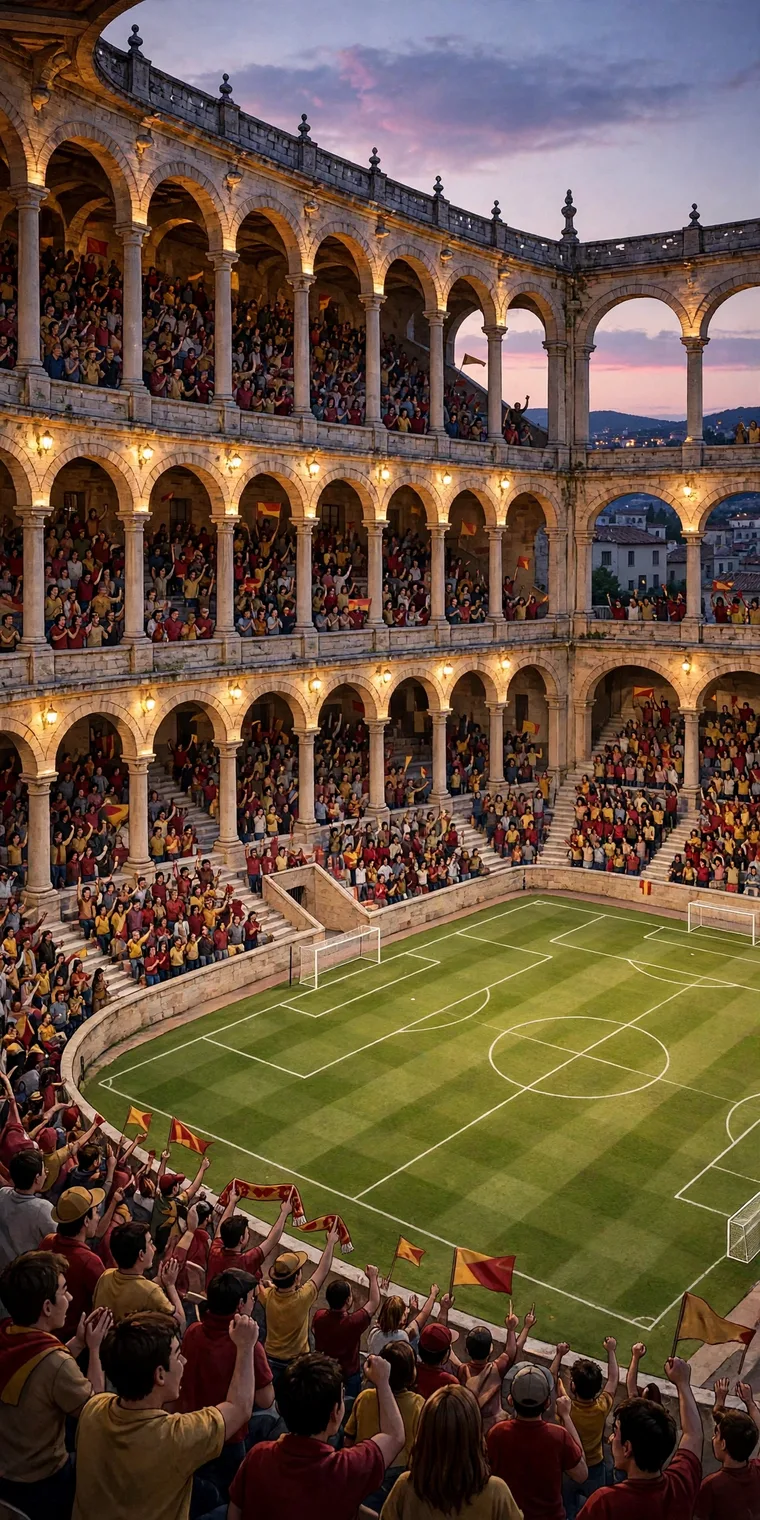
Every elite club scouts the planet. Athletic Bilbao scouts a homeland. Since the early twentieth century the club has fielded only players born in the Basque Country or raised and trained in its football system — a policy known simply as the cantera, the quarry from which local talent is cut. In an age of sovereign wealth funds, global transfer networks and squads assembled on spreadsheets, Athletic has chosen the opposite path, and the astonishing thing is that it has worked. The club has never been relegated from La Liga. Only Real Madrid and Barcelona can say the same.
To outsiders it looks like self-sabotage. To Bilbao, it is everything.
What the Policy Actually Says
The Basque Country, in Athletic's working definition, is broader than the autonomous community of the same name. It includes Bizkaia, Gipuzkoa, Álava and Navarre in Spain, and the French Basque territories of Labourd, Lower Navarre and Soule. A player qualifies by being born there, or by being formed there — joining a Basque club's youth system and learning the game in that football culture. That second clause matters. It has allowed sons of immigrant families who grew up in Bilbao, Barakaldo or Pamplona to wear the red-and-white stripes, and it makes the policy one of formation rather than blood. Critics abroad sometimes misread it as ethnic exclusion. Supporters answer, with some force, that a boy of Senegalese, Moroccan or Romanian parents raised in Bizkaia is as eligible as any other local child. What the club will not do is buy a ready-made star from another region simply because he is available.
The cost is obvious. Athletic cannot chase a striker in South America when injuries bite. Its pool is perhaps three million people, not three billion. The benefit is less obvious and more powerful: identity that cannot be bought by a rival. When Iñaki Williams, born in Bilbao to Ghanaian parents, runs the length of San Mamés, or his younger brother Nico, hero of Spain's Euro 2024 final, tears down the wing, the crowd is not cheering a recruitment strategy. It is cheering its neighbours, its schools, its own youth tournament last Sunday. Lezama, the club's academy outside Bilbao, opened in 1971, is less a facility than a civic institution. Its graduates know they are not passing through. They are the product.
That continuity produces a distinctive kind of pressure. A poor season cannot be blamed on foreign mercenaries. A great one, like the Copa del Rey triumph of April 2024 — Athletic's first major trophy in forty years, won on penalties against Mallorca in Seville, celebrated by hundreds of thousands along the Nervión river a week later aboard the traditional gabarra barge — feels like vindication for an entire society. The gabarra had been waiting since 1984. Children who had only seen it in photographs finally saw it sail. No transfer window produces a moment like that.
There are tensions, honestly discussed in Bilbao. Athletic's best players are constantly courted; Nico Williams' release clause has been a story across Europe. The women's team follows the same philosophy, with the same limits. Yet the socios, the members who elect the president, have never voted the policy away. Mid-table with their own means more to them than a title bought with someone else's.
The Other Cathedral: The Frontón
Walk away from San Mamés on a Sunday and you may hear Basque sport in its older form before you see it: a hard, rhythmic crack echoing off stone. That is pelota.
Basque pelota is a family of court games played against a wall, the frontón, with the hand, a wooden bat, a racket, or, in its most spectacular form, a cesta, the long curved wicker basket that launches the ball at terrifying speed in cesta punta, known internationally as jai alai — from the Basque for “merry festival.” The ball, wrapped in leather over a hard core, can travel faster than in almost any other ball sport. Players in Florida, the Philippines and Mexico once made jai alai a glamorous betting spectacle; its great frontons in Miami were cultural landmarks. At home, the heartland remains the village frontón, often built into the main square beside the church and the town hall — an architectural trinity that tells you exactly where pelota ranked in community life.
Hand pelota, pelota mano, is the purest version. No glove worthy of the name, just a hardened hand, tape, and years of conditioning, driving a ball that feels like a stone. Champions such as Retegi II and Olaizola II became household names in the Basque Country and Navarre. Matches are social rituals: betting calls, red and blue shirts, long rallies, and an argument over a line call that continues in the bar. Variants such as pala, remonte and xare survive in smaller circuits.
Pelota also explains something about Athletic. Both sports prize pertenencia, belonging, over spectacle. Both are technically demanding, locally rooted, and indifferent to whether the wider world is watching. The frontón does not need global television. It needs a wall, a village and two players who learned as children in that square. Athletic, for all its European nights and television income, still sells the same promise: what happens here comes from here.
Why It Matters Beyond the Basque Country
It would be easy to file Athletic and pelota under folklore. That would miss their challenge to modern sport. They ask whether a community is entitled to put limits on ambition in order to protect meaning — whether winning is the only measure, or whether how and with whom you compete can be achievements in themselves.
Athletic's answer has kept the club relevant for more than a century, produced internationals for Spain in every generation, and filled a 53,000-seat stadium that locals call, without embarrassment, La Catedral. Pelota's answer has survived industrialisation, television and the rise and fall of jai alai abroad, because every town still has a wall and every festival still finds room for a match.
Visit Bilbao on a match weekend and do both. Stand in San Mamés when the hymn rolls down and eleven locally formed players walk out against a team bought from four continents. Then find a frontón in the Casco Viejo or a nearby town, watch a hand-pelota match up close, and listen to that crack off stone. You will understand that in the Basque Country sport is not content. It is a language a place speaks to itself — and Athletic and pelota are its two clearest sentences.
© 2026 InsideRealSpain.com