Everybody Dances: Sevillanas, the Feria, and Spain's Most Democratic Dance
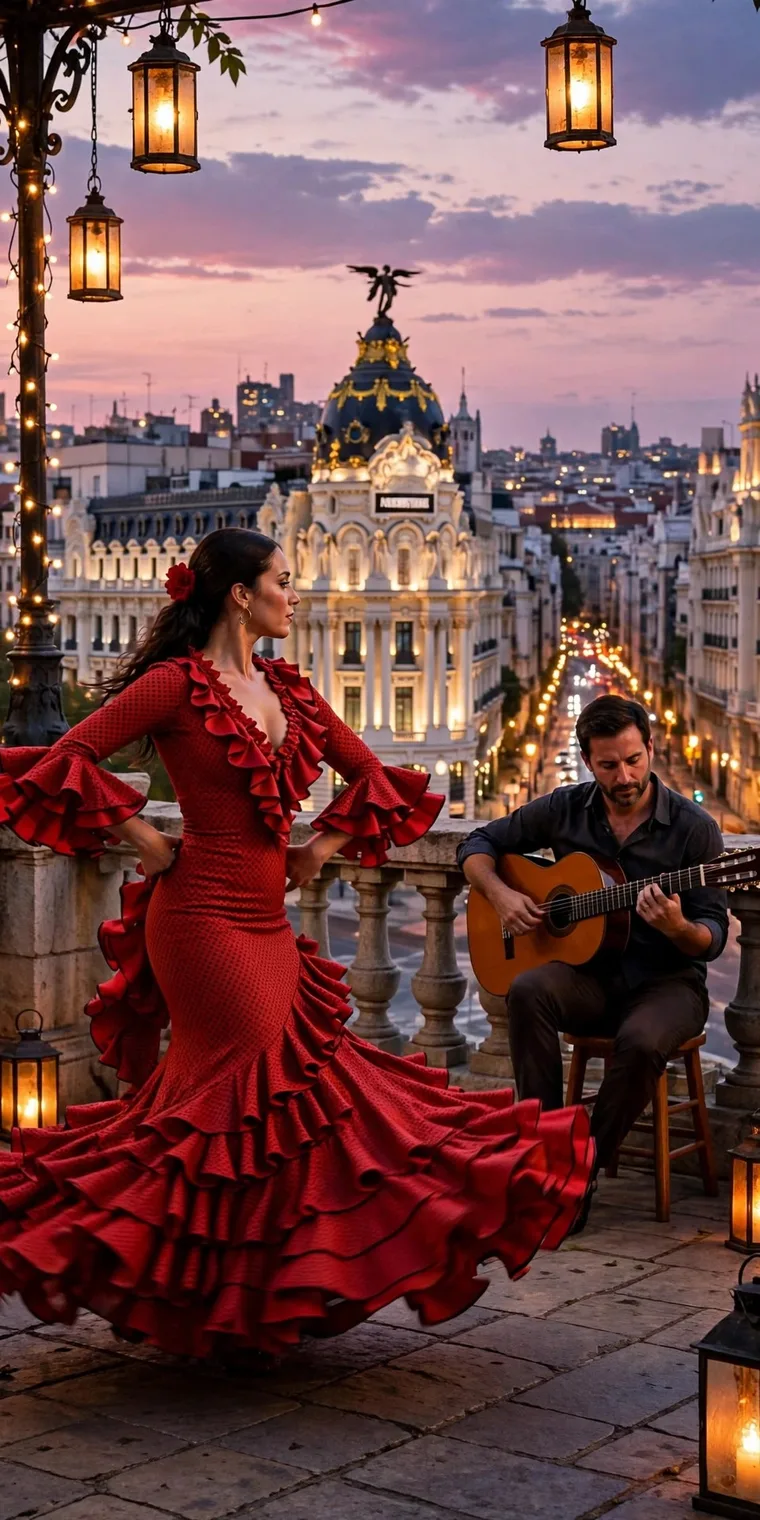
Every April, two weeks after Easter, Seville performs a collective transformation with no real parallel in Europe. The Feria de Abril begins Monday night with the alumbrao, the switching-on of hundreds of thousands of lights in Los Remedios, and for six days the city conducts its social life in public, in costume, and — this is the essential point — dancing. Not watching dancing. Dancing. Grandmothers, toddlers, teenagers and bank managers all dance the same dance: the sevillanas.
If flamenco is Spain's great art of the solitary soul, the sevillanas are its great art of the couple, the circle and the crowd. To understand the difference, and why Seville guards both so fiercely, is to understand something central about how Andalusia organises joy.
Four Verses, One Architecture
The sevillana is a song and dance in 3/4 time, brisk and bright, built in a form so regular that its regularity is the source of its social power. A complete sevillana consists of four coplas — the primera, segunda, tercera and cuarta — and each copla is danced with its own set choreography, separated by brief instrumental interludes during which partners catch their breath, circle, flirt, adjust a shawl and prepare for the next figure. Learn the four parts once and you can dance with anyone, anywhere, for the rest of your life. That is not a metaphor. It is the actual social contract of the form.
The steps are precise without being punishing. Partners face each other, arms raised in the rounded frame borrowed from flamenco, and move through paseíllos — walking steps that advance and retreat — turns, crossings called pasadas in which partners exchange places, and sharp stops in which both freeze in profile as the music hits its cadence. Women traditionally dance in the ruffled traje de flamenca, reinvented by designers every year; men in suits or the traje corto. But the dress is decoration. The discipline is in the count.
Because the form is fixed, it is radically inclusive. A skilled dancer can carry a beginner through all four coplas by pressure of the hand, and at the Feria this happens constantly: mixed pairs of experts and novices, parents hoisting children through the turns, strangers recruited from the edge of a caseta because nobody should sit out a sevillana. Dance schools across Andalusia fill up every February and March with adults taking refresher lessons, not from vanity but from something closer to civic duty. Arriving at the Feria unable to dance is like arriving at a dinner party unable to hold a conversation.
Neither Quite Flamenco Nor Quite Folk
Purists will tell you, correctly, that the sevillanas are not technically a palo of flamenco. They descend from the seguidillas castellanas of La Mancha and Castile, which travelled south, absorbed Andalusian phrasing and guitar style, and by the nineteenth century had become Seville's own. Yet the mood is flamenco's opposite in one crucial respect. The deep song digs inward, toward solitude and fate. The sevillanas turn outward, toward the partner, the group and the street.
The lyrics tell that story. Classic sevillanas sing about the Rocío pilgrimage, the Guadalquivir, bullfighters and Virgins — but also, in thousands of newer verses, about football, ex-boyfriends and the price of everything. Each generation pours its own life into the form. Los Romeros de la Puebla carried it across Spain, and Los del Río — whose "Macarena" became one of the biggest-selling singles in history — carried it around the world. Yet a sevillana played in Seville in April does work no recording can reproduce.
Inside the Caseta
The Feria's social machinery is the caseta: more than a thousand striped canvas tents, most private, run by families, companies, brotherhoods and groups of friends who pool money all year for six days of eating, drinking and dancing. The private system is exclusion, deliberately — the Feria is not a festival staged for visitors but a city celebrating itself, which visitors are welcome to witness. A handful of municipal casetas are open to everyone, and they are where the unconnected should start: order a fino or a rebujito — manzanilla sherry stretched with lemon-lime soda — and wait for the music.
Inside any caseta, the sevillanas observe their own etiquette. Dancing happens in ruedas, loose circles of couples that expand to fill the space. You do not cut through a rueda; you walk around it. You applaud the older couples, because age is no handicap — a woman of eighty with perfect arms and timing will be watched with more admiration than a girl of twenty with neither. Children dance in the early evening until they fall asleep on stacked chairs while their parents dance on. Around three in the morning the sevillanas give way to looser rumbas, private jokes replacing public form.
The daytime Feria belongs to the horses — riders and carriages in the gleaming paseo de caballos. But the horses go home at night. The sevillanas do not.
Rocío: Where the Song Goes on Pilgrimage
Follow the sevillanas west in late spring to El Rocío, the white village at the edge of the Doñana marshes. At Pentecost, around a million pilgrims converge for the Romería del Rocío, many travelling for days in ox-drawn wagons along sandy tracks. The sevillana rociera is that journey's soundtrack — sung around fires, sung to the Virgin's image, sung by people who have walked fifty kilometres and intend to sing the last one too. In the same week the form serves as party music, courtship dance, prayer and regional anthem, its devotion heartfelt without ever becoming solemn: the Virgin, La Blanca Paloma, is addressed like a beloved neighbour. Flamenco's deep song stands before death and does not look away. The sevillanas stand before life — marriage, harvest, pilgrimage, spring — and insist on dancing anyway.
For the visitor, this is the one great Spanish dance that genuinely wants you. You need four coplas, a patient partner and the willingness to be bad in public for one song. Stand at the edge of a rueda long enough and someone will pull you in. It will be too fast; you will turn the wrong way in the tercera and be rescued, laughing, by the structure itself — because the sevillana was designed so that the group carries the individual through. That is why a whole city dances it every April, and why the last sound in the last casetas is the opening guitar figure of one more sevillana, and everybody, once again, getting to their feet.
© 2026 InsideRealSpain.com