Five Roads to One Tomb: Choosing Your Camino
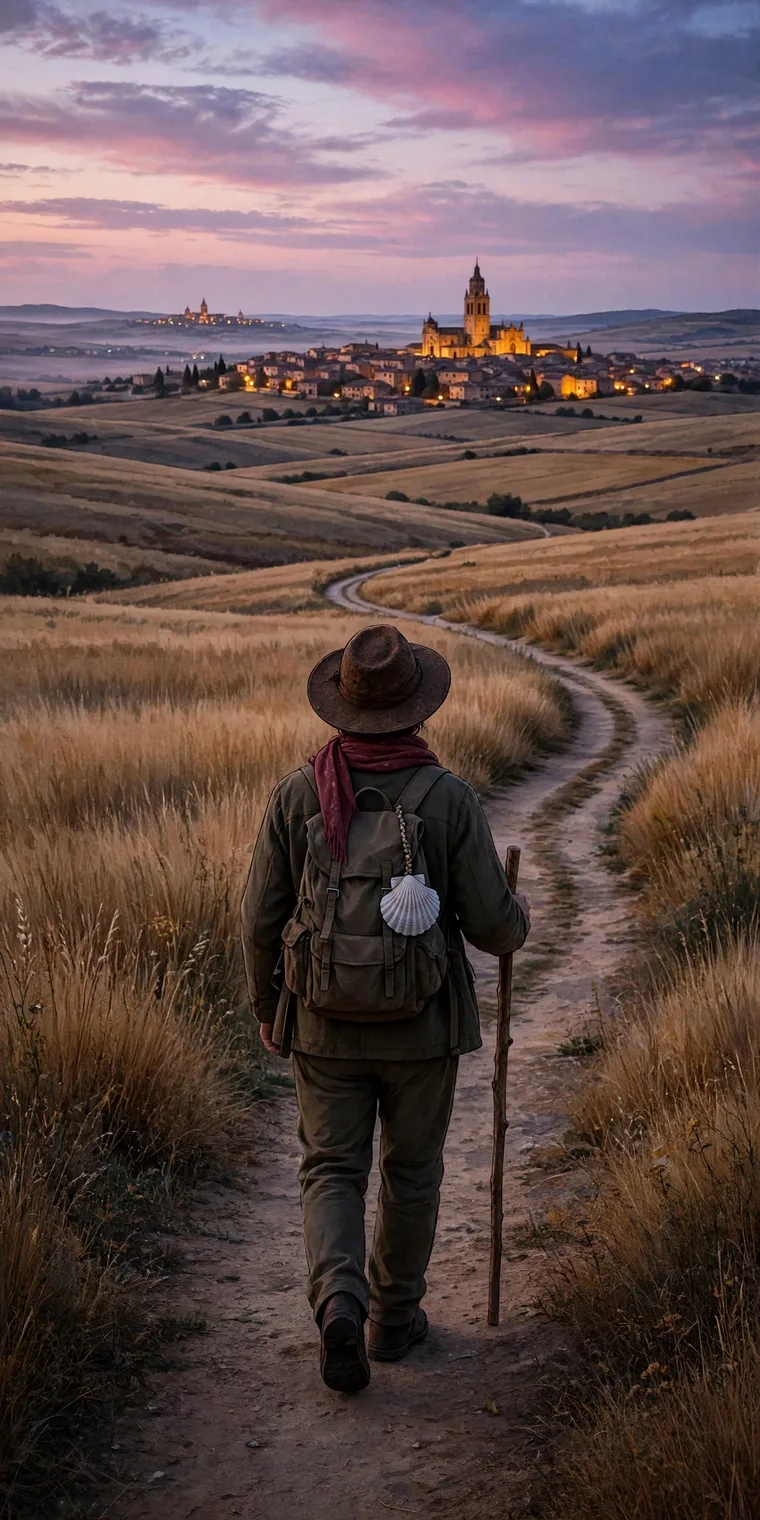
Every Camino ends in the same place: the Praza do Obradoiro in Santiago de Compostela, looking up at the twin towers of a cathedral that has received pilgrims for more than eight centuries. The Camino de Santiago is not a single trail but a network across Spain and Portugal — and the route you choose decides the weather, the food, and the kind of tired you will be on arrival.
The Francés: The Classic
The Camino Francés is the route most people picture. It begins in Saint-Jean-Pied-de-Port, on the French side of the Pyrenees, and runs roughly 780 kilometres west to Santiago. The first day explains its legend: a climb over the Route Napoléon to Roncesvalles, often through mist, wind, or late snow, that humbles almost everyone before supper.
From there it unrolls like a survey of northern Spain. Pamplona gives way to the wine country of La Rioja — Logroño, Nájera, Santo Domingo de la Calzada, where the cathedral keeps live hens in honour of a medieval miracle. Then comes the meseta, the high, flat, wheat-coloured plateau between Burgos and León. There is almost no shade and the horizon barely changes for hours. Many walkers skip it; those who stay often say the meseta is where the walk stops being a holiday and becomes an interior exercise.
The Francés is the best-supported route by far. In season you are rarely more than a few kilometres from a café, a pharmacy, or a bed. That is its blessing and its cost: in May, June, and September, especially on the final 100 kilometres from Sarria, it can feel crowded. For a first Camino it remains the benchmark — not because it is the most beautiful, but because it is the most complete.
The Norte: The Sea on Your Right
If the Francés crosses Spain, the Camino del Norte hugs it. Starting in Irún, this route of about 825 kilometres follows the Cantabrian coast through the Basque Country, Cantabria, and Asturias before turning inland in Galicia. For weeks the rule is simple: keep the sea on your right.
Instead of long flats, the Norte is a rhythm of headlands, river mouths, fishing ports, and climbs. A day might begin in San Sebastián — arguably the finest eating city on any Camino — and end in a harbour town smelling of grilled fish and salt. Further west come Santander, Santillana del Mar, and Asturian cider country.
The Norte is tougher on the legs and lighter on company. Stages are often longer between services, and Cantabrian rain is a personality trait of the region. In return you get coastal scenery no other route can match and dormitories where conversation still outnumbers phone screens. Choose it if you are fit, if you have already walked the Francés, or if a pilgrimage with the Atlantic beside it matters more than medieval monuments.
The Portugués: The Gentle Road from the South
The Camino Portugués approaches Santiago from the south, out of Portugal. The classic line starts in Lisbon — about 620 kilometres — though many begin in Porto, reducing the walk to roughly 240 kilometres. From Porto there are two personalities: the Central route through Barcelos and Ponte de Lima, crossing the border at Valença–Tui, and the Coastal route through Viana do Castelo and Caminha, rejoining the Central at Redondela.
This is the second most popular Camino, and its appeal is obvious. The gradients are kind, the villages close together, and the walk is measured in long lunches: grilled sardines, caldo verde, slightly sparkling vinho verde.
Once across the Minho into Tui, whose fortified cathedral stands like a border guard, the route is Galician to the bone: Pontevedra, Caldas de Reis and its hot springs, and Padrón, tied to the legend of the apostle's boat and home to the small green peppers that bear its name. For walkers short on time or travelling with older knees, the Portugués from Porto is the most forgiving serious Camino there is.
The Primitivo: The Original
The Camino Primitivo makes a claim none of the others can: it was first. When news reached King Alfonso II of Asturias in the ninth century that a tomb believed to be that of the apostle James had been found in Galicia, he travelled from Oviedo to see it. That royal journey — about 320 kilometres through the mountains — is regarded as the original pilgrimage.
It is also, kilometre for kilometre, the most demanding of the popular Caminos. From Oviedo the path climbs into the Asturian mountains, where the famous Hospitales variant crosses a high, exposed ridge past the ruins of medieval pilgrim hospitals — magnificent in clear weather, serious in fog or wind. Nothing is truly gentle until Lugo, whose complete Roman walls you can walk along the top, and where the Primitivo joins the Francés at Melide.
It draws experienced walkers, often on a second or third Camino. Two weeks is enough time. Fitness is not optional.
The Vía de la Plata: The Long Road from Seville
Finally, the giant. The Vía de la Plata begins in Seville, under the Giralda, and runs about 1,000 kilometres north — the longest Camino entirely within Spain. Its name means the Silver Way, and it follows, in large part, a Roman road built to move goods, legions, and silver between south and north.
This is a Camino of scale and silence. It crosses Extremadura — Mérida, with its Roman theatre and bridge, and Cáceres, whose old town is a stone film set — then Salamanca and Zamora, cities of golden stone. Distances between towns can stretch past 30 kilometres. In summer the southern half is dangerously hot; this is a spring or autumn walk, ideally starting in March or April when Extremadura is green and briefly flower-covered.
The Plata rewards the self-reliant pilgrim who loves Roman Spain and empty horizons. You may walk a whole morning without meeting another walker — now impossible on the Francés in season.
So, Which Road?
Ask honest questions. How many days do you truly have? Four weeks opens the Francés, the Norte, or the Portugués from Lisbon. Two weeks points to the Primitivo, the Portugués from Porto, or the Francés from León. How do you feel about people? The Francés and Portugués are social; the Plata and Primitivo are contemplative; the Norte sits between. What season? The Plata punishes summer walkers; the Primitivo's mountains demand respect from November to April.
There is no wrong answer, only mismatched ones. Choose well, and Santiago will do the rest.
© 2026 InsideRealSpain.com