Follow the Shell: How Yellow Arrows Rewrote the Map of Northern Spain
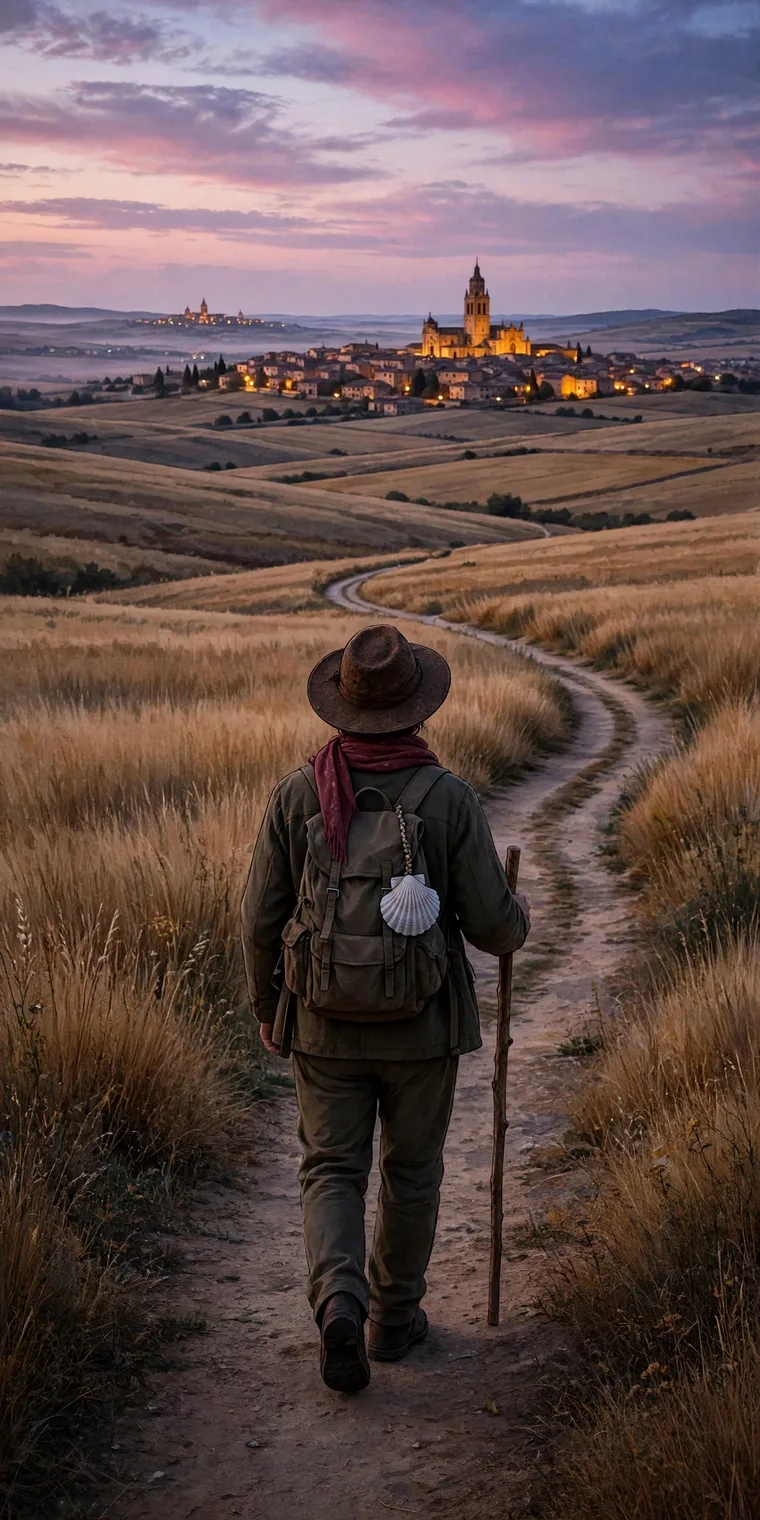
You can walk 780 kilometres across a foreign country, through mountains, wheat plains, and Galician fog, without a map, without an app, and — for long stretches — without seeing another person, by following two marks: a stylised scallop shell and a yellow arrow. Together they form one of the most successful waymarking systems on earth. They are also easy to misunderstand. The shell is ancient, famous, and frequently pointing the wrong way for navigation. The arrow is modern, humble, and the thing that actually keeps you from getting lost. The Camino works because pilgrims learn to trust the second while revering the first.
The Shell That Came from the Sea
The scallop — vieira in Galician, coquille Saint-Jacques in French — is bound to Santiago for a practical reason before any symbolic one. Scallops are native to the Galician coast, not far from where the apostle James was said to have been buried. Medieval pilgrims who reached Santiago, and sometimes continued to Finisterre on the Atlantic, picked up a shell as proof they had completed the journey. It was light, durable, unmistakably from that shore, and useful: a cup, a scoop, a small plate.
From proof it became badge, and from badge, symbol. By the twelfth century the shell was sewn onto cloaks and hats, carved over church doors across Europe, stamped onto documents, and sold — sometimes fraudulently — far from Galicia, to the irritation of church authorities who tried to reserve its sale to Santiago itself.
Real shells still swing from backpacks all along the routes. The shell on a rucksack today is a declaration — I am a pilgrim. The credencial proves the walk; the shell announces it.
Reading the Shell on the Road — Carefully
On official markers, the shell appears in its modern design: yellow lines radiating on a blue background, set into concrete monoliths, plaques, and tiles. Here is the trap for newcomers. The direction the shell's rays point is not consistent across Spain. In Galicia, the design on the stone mojones is generally arranged so you follow the direction in which the rays converge — but in other regions the shell may be oriented differently, treated as an emblem rather than an arrow.
The rule that saves confusion is simple: the shell confirms you are on the Camino; the yellow arrow tells you which way to go. When a monolith carries both, obey the arrow. When a shell appears alone on a church, a fountain, or a bar wall, take it as encouragement, not instruction, and look around for paint.
The Priest with a Paint Pot
The yellow arrow is startlingly recent. Its great promoter was Don Elías Valiña Sampedro, parish priest of O Cebreiro, the mountain village where the Francés enters Galicia. In the 1980s, when the Camino was still a fading memory kept alive by a few thousand walkers a year, Valiña studied the historic routes, drove them in his small car, and marked the way with yellow arrows painted with surplus paint — legend says, paint intended for road markings. He also helped restore O Cebreiro itself and its church of Santa María la Real.
It is hard to overstate what those arrows did. A pilgrimage that had required local knowledge, guidebooks in several languages, and a tolerance for getting lost became navigable by anyone who could follow paint. Valiña died in 1989, just before the great revival of the 1990s, but his invention conquered the network. Today yellow arrows appear on tree trunks, kerbstones, lamp posts, farm gates, the backs of road signs, and the corners of houses from the Pyrenees to the Portuguese border and down to Seville. Volunteers and local associations repaint them, season after season, in one of Europe's largest acts of anonymous maintenance.
The arrows have a particular grammar. A single arrow on a wall as you enter a village means continue. An arrow at a fork, sometimes doubled for emphasis, settles the argument. A yellow X on a path means not this way — a negative sign walkers learn to respect, especially in Galicia's maze of lanes. After rain, in fog, or at a busy road junction, arrows can be missed, which is why experienced pilgrims develop the habit of looking back at a junction to check the route for those coming the other way, and of pausing when no mark has appeared for ten minutes. On the Camino, absence of arrows is information.
A Language Everyone Can Read
Part of the system's genius is that it crosses every language barrier on a route walked by Koreans, Brazilians, Germans, Poles, Americans, and Japanese in large numbers. Add the blue-and-yellow shell signs used on European cultural route markers, the distance figures carved on Galician monoliths — counting down, encouragingly, to Santiago — and the occasional ceramic tile in a village wall, and you have a visual language learned within a day and never forgotten.
In Galicia the monoliths also show the remaining kilometres with decimal precision. Pilgrims photograph them as the numbers fall below 100, then 50, then 10 — the goal becomes arithmetic, shrinking with every hour walked.
Routes are occasionally diverted, rival arrows painted by businesses exist, and apps sometimes disagree with the paint. When they do, follow the paint, check your position at the next village, and remember a short detour is rarely a disaster. It is sometimes lunch.
Carrying the Symbols Home
By the end of a long Camino, the shell and arrow stop being signage and become something closer to a private shorthand. Pilgrims have them tattooed, stitched onto jackets, and carved into walking sticks. Towns along the Francés have built them into pavements and plazas. Santiago itself is saturated: shells in the cathedral stonework, shells in silver in the jewellers' windows of the old town, shells pressed into the very square where the walk ends.
That saturation would have pleased Valiña, and perhaps puzzled the medieval pilgrims who started it all with a real shell from a real beach. But the continuity is genuine. A symbol that began as evidence — I was there, I reached the tomb — became a guide pointing the other way: go there, the road is marked. The yellow arrow is only forty years old, the shell more than eight hundred, and together they do what the Camino has always done: take something ancient and make it usable by whoever arrives next, on foot, looking for the next mark.
© 2026 InsideRealSpain.com