Rioja vs. Ribera del Duero: Spain's Eternal Tempranillo Debate
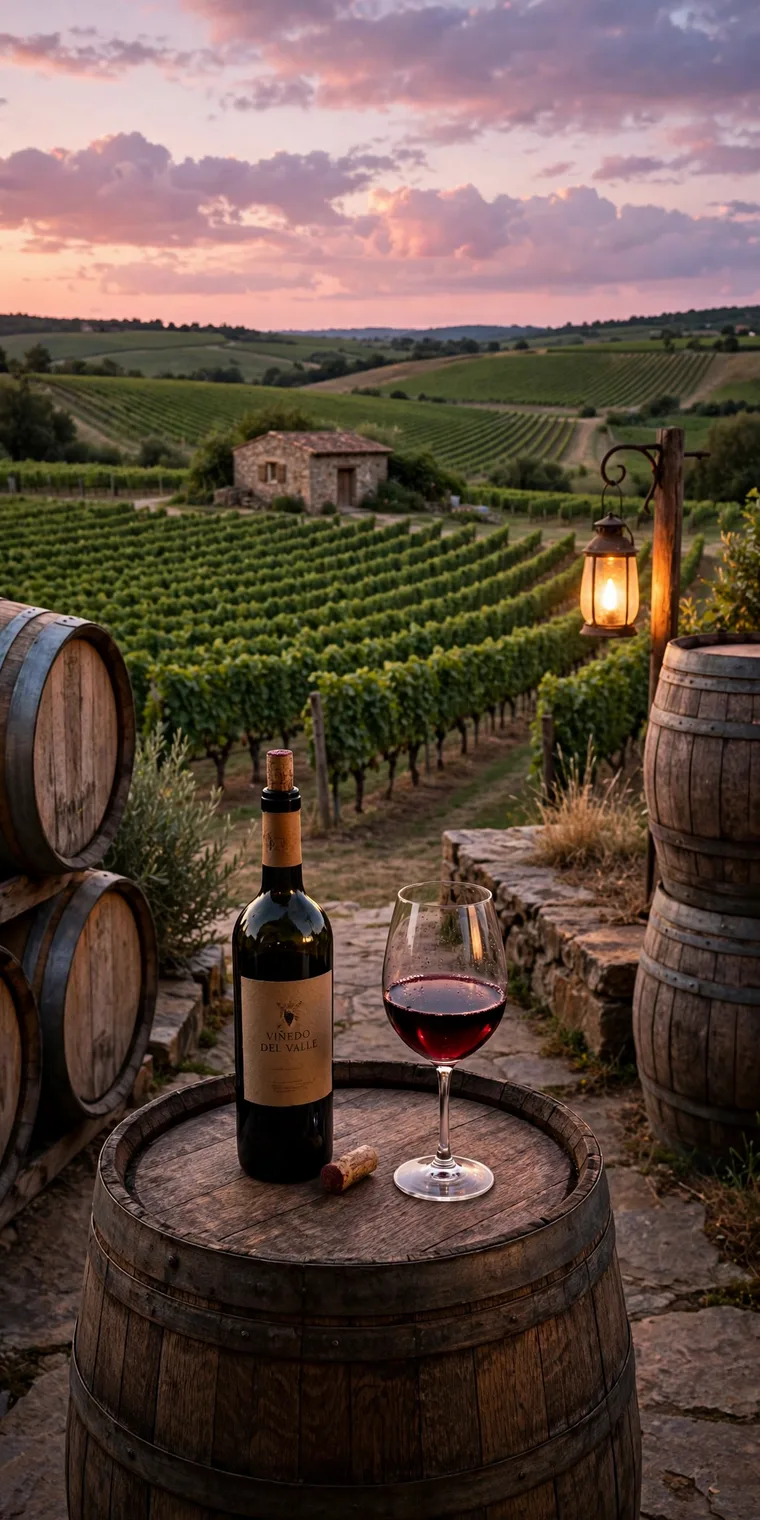
If Spain has a signature red grape, it is Tempranillo. Thick-skinned and early-ripening — its name comes from temprano, early — it can be both silk and structure. Yet Tempranillo is not one wine. Grow it in the limestone and clay of Rioja, blend it, and age it for years in oak, and you get something perfumed and patient. Grow it farther southwest, at altitude along the Duero River, through scorching days and freezing nights, and you get a darker, more muscular wine speaking a different dialect of the same language.
Spaniards will argue happily for hours about which is greater. That argument is the point. Rioja and Ribera del Duero are not rivals where one must lose. They are two classic answers to the same question: what can Tempranillo become when a place insists on making it honestly?
Rioja: Where Time Is an Ingredient
Rioja stretches about 75 miles along the Ebro River, sheltered by the Sierra de Cantabria. It divides traditionally into Rioja Alta in the west, higher and cooler with Atlantic influence; Rioja Alavesa, across the river in Basque territory, on limestone hills that produce some of the most elegant wines; and Rioja Oriental, warmer and drier to the east, where Garnacha has historically thrived.
The classic recipe is mostly Tempranillo, with Garnacha, Mazuelo, and Graciano in support, followed by long aging in 225-litre barrels — traditionally American oak, which adds coconut, vanilla, and dill — and then in bottle. Spain codified that patience. Crianza requires at least two years' aging, at least one in barrel. Reserva requires at least three years, at least one in barrel. Gran Reserva requires at least five years, at least two in barrel and two in bottle. Great houses often go far beyond the minimums.
At its best, a mature Gran Reserva from Haro — whose Barrio de la Estación is lined with bodegas founded in the late 19th century, when French merchants came south after phylloxera devastated Bordeaux — is brick-red at the rim, with dried cherry, tobacco leaf, leather, cedar, and sweet spice. The palate is not about power. It is about resolution: tannins softened to a fine grain, acidity still alive after a decade, fruit traded for complexity.
Rioja is not frozen in that tradition. Since the 1990s many producers have moved toward single vineyards, earlier picking for freshness, French oak or concrete, and less extraction. In 2017 the rules added viñedo singular — certified single-vineyard wines — plus village and zone labelling. The internal debate is now as lively as the external one: should identity come from a bodega's house style, perfected over generations, or from a specific hillside?
For drinkers, both answers work. A young Crianza with lamb chops grilled over vine cuttings — chuletillas al sarmiento — is one of Spain's great simple pleasures. A mature Reserva with roast pork, wild mushrooms, or aged Manchego shows why cellaring matters. And a well-made Rioja Reserva, released only when ready to drink, remains one of the world's great wine values.
Ribera del Duero: Altitude and Extremes
If Rioja is about time, Ribera is about place — a demanding one. Vineyards follow the Duero, the same river that becomes the Douro in Portugal, across a high plateau in Castilla y León at 2,300 to over 3,000 feet. Summers are short and hot, winters bitter, and the swing between afternoon and night can exceed 40 degrees Fahrenheit.
Tempranillo here, called Tinto Fino or Tinta del País, has adapted: smaller berries, thicker skins, looser bunches, naturally low yields. Wines are deeper in colour, firmer in tannin, and concentrated in black fruit — blackberry, plum, cassis — with graphite and liquorice, or, from limestone plateaus, a chalky freshness that balances the power.
Ribera's modern fame is young. Vega Sicilia, near Valbuena de Duero, was founded in 1864, but the Denominación de Origen dates only to 1982, with a handful of bodegas. Pesquera then proved that 100 percent Tinto Fino could be world-class. Dominio de Pingus, founded in the 1990s by Peter Sisseck from tiny plots of old vines, became a cult wine. Investment transformed the country around Roa, La Horra, and the so-called Golden Mile near Valladolid, where flagship estates cluster within a few kilometres.
Ribera uses similar aging terms to Rioja, but many of its most exciting wines are released younger, after 12 to 15 months in barrel, prioritising fruit intensity over Rioja's long arc. A five-year-old Ribera Reserva with lechazo — roast suckling lamb from a wood oven in Aranda de Duero — is a pairing so perfect it feels inevitable: tannin cuts the fat, acidity refreshes, dark fruit mirrors caramelised meat.
Altitude is also Ribera's climate advantage. Cold nights preserve acidity as summers warm, though frost and drought are constant threats. The best producers now talk less about power and more about precision: earlier picking, limestone soils, larger and older barrels that do not mask the fruit.
How to Tell Them Apart
Side by side, the lesson teaches itself. Rioja is usually paler, garnet rather than purple, leading with red fruit and spice — strawberry, cherry, clove, cedar. Ribera is darker, often nearly opaque in youth, leading with black fruit. Rioja tends to be medium-bodied and linear, with acidity as its spine. Ribera tends to be fuller, denser, with firmer tannins. Oak is a clue, not a rule: traditional Rioja favoured American oak, Ribera French, but modern producers in both regions blur the line.
Spain is lucky to have both. Rioja built global trust by releasing wine when it was ready to drink, not when the winery needed cash — a radical, expensive commitment. Ribera proved that country dismissed for generations as bulk-wine land could, within two decades, produce wines to sit beside Bordeaux and Barolo. Taste Tempranillo in both places and you learn something larger: in Spain, identity is local, pride is earned, and no single style gets the last word.
© 2026 InsideRealSpain.com